
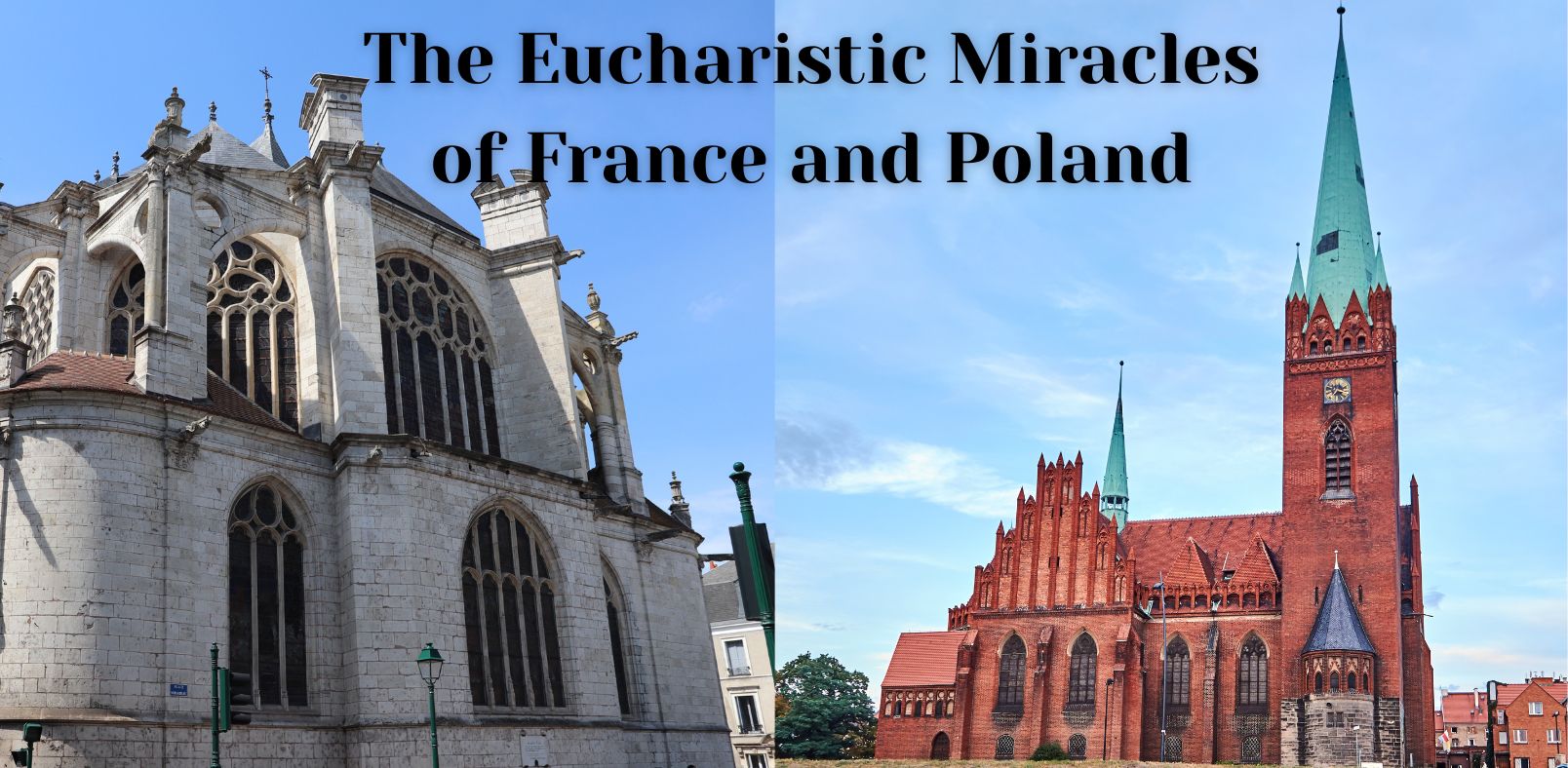
The Eucharistic Miracles of France and Poland
When people discuss Eucharistic miracles, they typically refer to those rare instances when the mystery of the Eucharist seemed to transcend ordinary reality in a way that left witnesses astonished. For Catholics, these events are reminders of the Church’s belief in the Real Presence of Christ. And while stories like Lanciano in Italy often come up first, France and Poland each hold their own extraordinary accounts that still draw pilgrims centuries later, or in some cases, only a few years later.
Paris in 1194: A Bleeding Host
Paris at the end of the 12th century was already a busy center of faith and study. In 1194, a woman struggling with poverty handed over a consecrated host to a man for money. The man, curious or skeptical, pierced the host with a knife. To everyone’s shock, it bled.
The story spread through the city and beyond. Crowds gathered, priests carried the host in procession, and for generations the miracle was remembered as a visible sign of Christ’s presence. Even though the original church was torn down during the French Revolution, the event was never forgotten. A plaque in Saint Madeleine in Paris quietly reminds today’s visitors of what once happened in the heart of the city.
Faverney in 1608: Fire That Could Not Touch
Move forward a few centuries to a small Benedictine monastery in Faverney, eastern France. The monks had placed the Blessed Sacrament on the altar for adoration during Pentecost. Late at night, flames spread through the chapel. Wooden furniture burned, but witnesses reported something impossible: the monstrance containing the Eucharist was suspended in the air, hovering above the fire for more than thirty hours.
When the smoke cleared, the host was unharmed. People poured into the town, and Church officials investigated. The monstrance can still be seen in Faverney today, a reminder that faith sometimes survives the flames, literally.
Poland: Sokółka in 2008
Centuries later, far from France, a small Polish town became the setting for another startling event. In 2008, in Sokółka, a consecrated host was accidentally dropped during the Communion service. Following standard procedure, the priest placed it in water to dissolve. Instead, the host developed a reddish stain that did not fade.
Scientists who examined it found human heart tissue, torn and showing signs of distress. For many believers, that detail felt deeply symbolic: a suffering heart, linked to Christ’s own passion. The host is preserved, and Sokółka has since become a place of prayer and pilgrimage.
Legnica in 2013
Not long after Sokółka, another Polish town made headlines. In Legnica, a host that had fallen was also placed in water. Once again, rather than dissolving, it changed. The fragment revealed the same type of tissue: heart muscle, under duress. The case was reviewed and eventually approved for veneration by the Vatican.
Pilgrims now visit the Church of Saint Hyacinth in Legnica to reflect before the preserved host. For a modern country living in a strong Catholic tradition amid rapid secular change, the miracle felt like a reminder that faith still had something urgent to say.
Why These Stories Still Matter
It’s easy to dismiss miracles as medieval legends or stories that have been exaggerated over time. But what’s striking here is that they happen across centuries, cultures, and even under scientific investigation. France’s miracles belong to an age of kings and monasteries. Poland’s belong to our own lifetime, complete with lab tests and medical reports.
For believers, the connection is clear: whether it was a bleeding host in Paris, a monstrance that survived a fire in Faverney, or heart tissue found in a small Polish parish, the same message comes through. The Eucharist is not just bread and wine.
For skeptics, the stories remain puzzles, curious intersections of faith and mystery. But even they might admit there’s a moving aspect to the persistence of these accounts, passed down through generations, drawing people into churches large and small.
Walking the Pilgrim’s Road
Travelers who set out to visit these places find more than relics. They find living communities that continue to carry the memory of these events. In Paris, it’s a plaque in a busy church. In Faverney, a monstrance that somehow escaped fire; in Sokółka and Legnica, hosts carefully preserved behind glass.
Pilgrimage is as much about the inward journey as the outward one. People who walk into these chapels aren’t just tourists checking off a site. They’re asking, quietly, what these miracles mean for their own lives.
The Eucharistic miracles of France and Poland tell stories that are both ancient and new. They remind us that questions of faith, doubt, and wonder are not locked in the past. In a world that often prizes proof and explanation, these events still resist easy answers.
Whether you approach them as a believer seeking affirmation or simply as someone intrigued by the persistence of mystery, they invite reflection. Perhaps that’s their most incredible gift: to stir hearts, awaken questions, and keep alive the sense that in the Eucharist, something greater than bread and wine is offered to the world.