
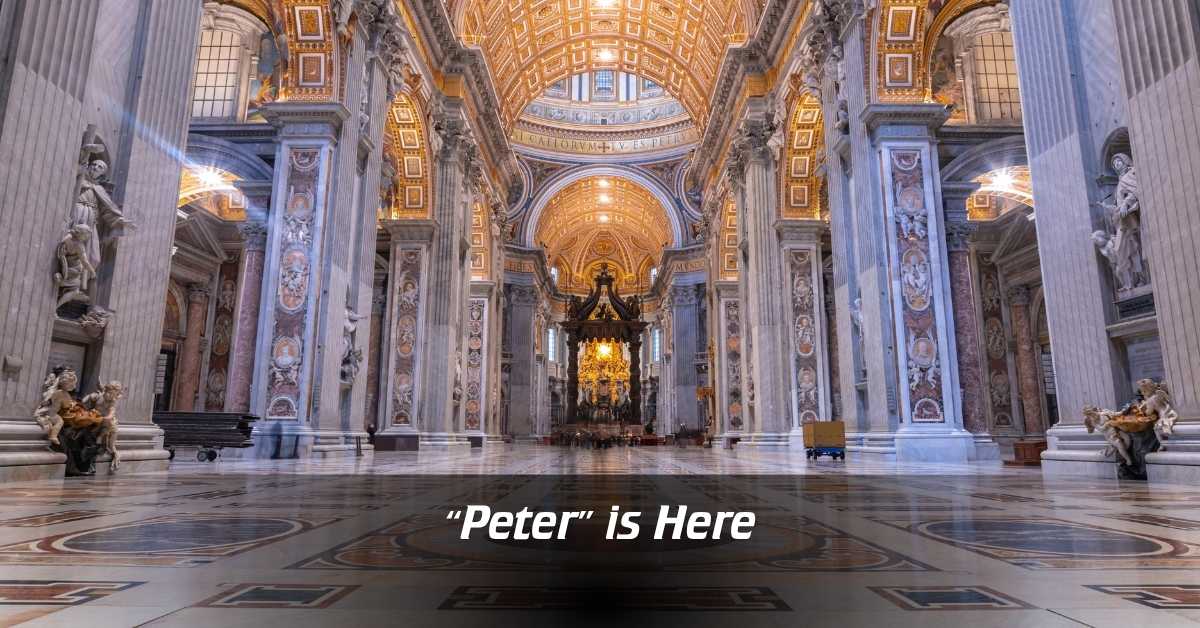
If you ever find yourself so fortunate as to visit the Scavi (literally the “excavation”) beneath the crypt of St. Peter’s Basilica, you will wander through the narrow corridors of the old necropolis that used to sit atop the Vatican hill. When Emperor Constantine landfilled this necropolis in the fourth century to build the first version of St. Peter’s church, he was absolutely insistent that the high altar of that church should be built directly over the site of Peter’s grave. In the present day, inside the excavated ruins, you can still see the simple monument the first-century Christians placed over Peter’s gravesite, which would be unmarked if not for the hundreds of graffiti etchings in the stone, all of them asking for prayers from Jesus’ beloved friend. Among the graffiti, scratched in blocky Greek letters, is one particular phrase: Petro eni, “Peter is here.” And sure enough, if you were to look through the centuries of brick, dirt, and stone above this monument, you would indeed be looking at the high altar of the current-day St. Peter’s Basilica. Like the Christians of Rome nearly 2000 years ago, when we stand in that church, we can truly say “Peter is here!”
Have you ever considered what it means when we call the pope “the successor of Peter?” The office of the pope is more than a ceremonial figurehead or a chief administrator. There is a line of direct connection from today’s Pope Leo XIV all the way back to Peter. But to be Peter’s successor is even more than to inherit a title; it also means to inherit an office, a responsibility, one anchored in a particular relationship with Jesus.
When Jesus ascended into heaven, he did not remove the network of relationships he built over his earthly ministry, but preserved them. That interconnected web of human connections became the foundations of the Church. Think, for example, of Mary, who at the crucifixion was made the Mother of the Church, for all believers across all time. The same goes for Peter: his unique relationship with Jesus continues in the office of the pope. Peter was not only an apostle, but the one who spoke on their behalf. He was the one who confessed “you are the Christ, the Son of the living God!” He was the one who experienced the mercy of Jesus firsthand after turning his back on the Lord completely. He was the one who witnessed key moments that revealed Jesus’ true nature and identity: the raising of a girl from the dead, the Transfiguration, the agony in Gethsemane. Peter is the Church’s chief eyewitness. He is the best friend of Jesus. He is not Jesus’ holiest or most faithful friend, nor is he always the greatest witness. However, he is the one Jesus chose as his Rock, and it was Jesus’ faithfulness to Peter that made Peter holy, that kept him as his best friend.
Twenty centuries have come and gone, and still “Peter is here.” In the history of our Church, we have had good popes, we have had saintly popes, and we have had truly awful popes. And yet the office of Peter remains, not on account of our faithfulness or unfaithfulness, but Jesus’ faithfulness to his friend Peter, as well as to his Church, the community he built upon Peter. When we go on pilgrimage and see the pope, we are seeing a man, a sinner the same as you and me, but we are also seeing something more behind the man: we are seeing Peter. “Peter is here.” We are seeing before our eyes Jesus’ faithful love to his Church, and to his friend Peter.
Sometimes it is easy to get lost in the more worldly and external elements of the papacy. “Oh, look at what Pope Leo said about this issue!” “Did you see what this foreign leader said about the pope?” And so on. Beneath all those things, however, there is the office and the relationship Pope Leo has inherited, one built on an unshakeable foundation: “You are the Christ.” “And I tell you, you are Peter.”